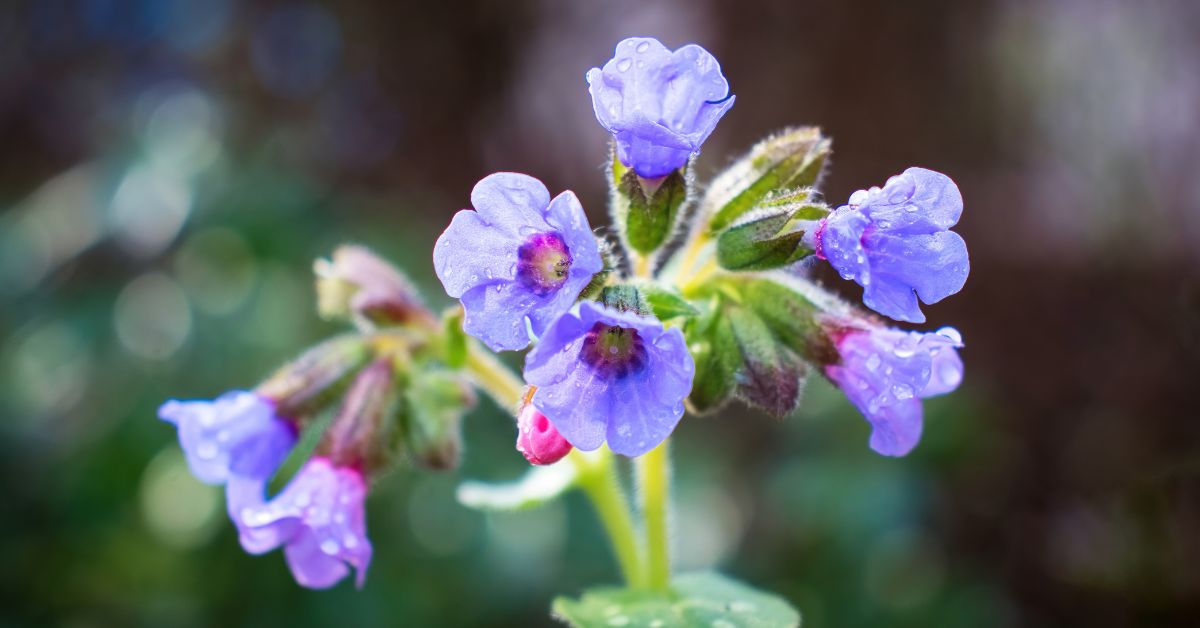
Spotted lungwort (Pulmonaria officinalis) is one of those medicinal herbs whose name itself reflects its traditional area of use. For centuries, folk medicine has primarily relied on it for various respiratory complaints, coughs, and catarrhal conditions. Although it is less well-known today than thyme or ribwort plantain, it remains a valuable herb in phytotherapy.
What makes spotted lungwort particularly interesting is that it contains mucilage, saponins, flavonoids, and silicic acid, which together may help support respiratory health. In addition, it possesses anti-inflammatory, mildly calming, and tissue-supporting properties.
What is spotted lungwort?
Spotted lungwort (Pulmonaria officinalis) is a medicinal herb native to Europe. In herbal medicine, the aerial parts of the plant are primarily used.
Its most important active compounds include:
- Allantoin
- Saponins
- Flavonoids
- Mucilage
- Silicic acid
- Tannins
Together, these compounds contribute to the plant’s:
- Anti-inflammatory
- Expectorant
- Mucous membrane-protective
- Tissue-supporting
- Mildly calming
effects.
Why is it called “lungwort”?
In medieval medicine, the so-called Doctrine of Signatures was widely accepted. According to this belief, a plant’s appearance could indicate which organ system it might benefit.
The pale spots on the leaves of spotted lungwort were thought to resemble lung tissue, which led people to traditionally use the plant for respiratory complaints.
Although modern phytotherapy no longer evaluates herbs based on appearance, it is interesting that lungwort did indeed become known primarily for supporting respiratory health.
Cough and respiratory irritation
The best-known use of spotted lungwort is the relief of:
- Coughs
- Throat irritation
- Respiratory tract irritation
Its mucilage content may:
- Coat irritated mucous membranes
- Reduce throat discomfort
- Help decrease the urge to cough
This may be particularly useful in cases of:
- Dry cough
- Throat irritation
- Hoarseness
Bronchitis and tracheitis
In traditional phytotherapy, spotted lungwort has also been used for:
- Bronchitis
- Tracheitis
- Catarrhal respiratory conditions
The saponins it contains may:
- Help loosen mucus
- Support the expectoration of stubborn secretions
- Promote airway clearance
As a result, the plant may provide both:
- Expectorant
- Mucous membrane-protective
properties.
Hoarseness and overworked vocal cords
One of the lesser-known uses of spotted lungwort is the support of hoarseness.
Thanks to its mucilage content, it may:
- Soothe irritated vocal cords
- Reduce throat scratching and discomfort
- Support vocal recovery
This may make it particularly interesting for:
- Teachers
- Public speakers
- Singers
Anti-inflammatory effects
The flavonoids and tannins found in the plant may:
- Help reduce inflammatory processes
- Support the regeneration of irritated mucous membranes
These anti-inflammatory properties may be beneficial not only for the respiratory tract but also for external applications.
Allantoin and tissue-supporting properties
One of the unique compounds found in spotted lungwort is allantoin.
Allantoin may:
- Support tissue regeneration
- Promote epithelial repair
- Contribute to the renewal of skin and mucous membranes
The plant’s silicic acid content may also help support connective tissues and structural tissue integrity.
Mild diuretic effect
Although spotted lungwort is primarily known as a respiratory herb, it has traditionally also been used as a mild diuretic.
However, this effect is considerably less pronounced than that of herbs such as stinging nettle or field horsetail.
External use
Spotted lungwort can be used not only internally but also externally.
It may be applied as:
- Compresses
- Washes
Due to its anti-inflammatory and regenerative properties, it may also be considered for:
- Irritated skin
- Minor skin complaints
How is it used?
As a tea
The most common method of use is herbal tea.
General preparation:
- Pour boiling water over 1–2 teaspoons of the dried herb
- Allow it to steep for 10–15 minutes
- Strain before use
As a compress
The prepared infusion can also be used as:
- A compress
- A skin wash
Precautions
Spotted lungwort is generally well tolerated, but it is not recommended in certain situations.
Avoid use:
- During pregnancy
- During breastfeeding
- In children under 3 years of age
As with any medicinal herb, persistent or severe symptoms should be evaluated by a qualified healthcare professional.
Spotted lungwort is a traditional medicinal herb primarily used for respiratory complaints such as coughs, bronchitis, tracheitis, and hoarseness. Its mucilage may help protect irritated mucous membranes, its saponins may support mucus clearance, while its flavonoids and allantoin may contribute to reducing inflammation and supporting tissue regeneration.
Although it is less well-known today than some other respiratory herbs, spotted lungwort remains a valuable component of phytotherapy, particularly for the natural support of respiratory health.