Shepherd’s purse is one of the best-known natural herbs traditionally used to help reduce excessive bleeding, especially in cases of heavy menstruation, menstrual cramps, and minor bleeding. It is also associated with vasoconstrictive and blood pressure-lowering properties, making it a particularly interesting medicinal plant in phytotherapy.
Although less widely known today, shepherd’s purse has played an important role for centuries in the natural support of gynecological and circulatory complaints.
What is shepherd’s purse?
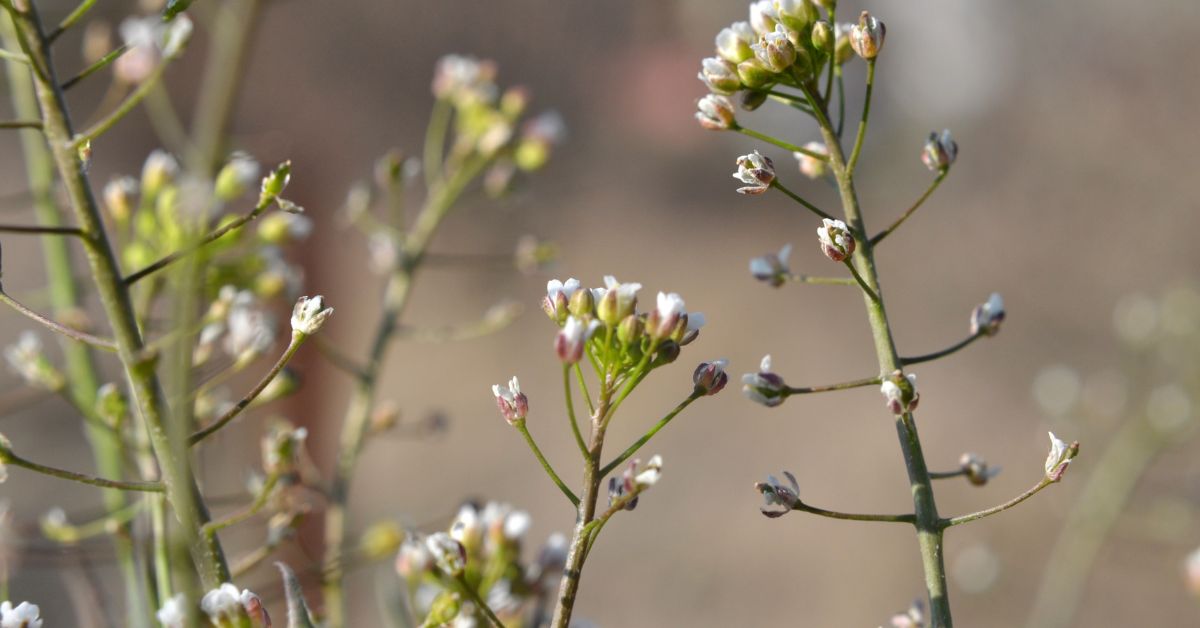
Shepherd’s purse (Capsella bursa-pastoris) is a modest-looking but widespread medicinal herb whose aerial parts — the above-ground herb — are used in phytotherapy.
Its most important active compounds include:
- flavonoids
- polypeptides
- potassium
Together, these compounds contribute to the plant’s:
- hemostatic (bleeding-reducing)
- vasoconstrictive
- anti-inflammatory
- uterine-contracting
properties.
Heavy menstruation and cramping
The best-known application of shepherd’s purse is the support of excessively heavy menstruation.
Traditionally, it was used when:
- menstrual bleeding was unusually heavy
- the bleeding lasted too long
- menstruation was accompanied by strong cramps and pain
The plant may:
- help reduce the intensity of bleeding
- support improved comfort
- ease certain cramping symptoms
According to traditional herbal use, shepherd’s purse may even shorten menstruation by 1–2 days in some cases.
Hemostatic effects
Shepherd’s purse was not used only for gynecological complaints.
In folk medicine, it was also traditionally known for:
- minor bleeding
- nosebleeds
- superficial skin injuries
Its vasoconstrictive properties may:
- support the reduction of bleeding
- help maintain vascular tone
Uterine-contracting properties
One of the plant’s most important characteristics is its uterine-contracting effect.
This explains why it is primarily associated with:
- heavy menstruation
- gynecological bleeding complaints
The herb may:
- support natural uterine contractions
- contribute to reducing excessive bleeding
Blood pressure-lowering effects
Fewer people know that shepherd’s purse is also traditionally associated with blood pressure-lowering properties.
This may be related to its:
- vasoconstrictive
- circulation-supporting
effects.
For this reason, it is generally not recommended for individuals with low blood pressure.
Mild antispasmodic support
Although shepherd’s purse is primarily known as a bleeding-supportive herb, in some cases it may also offer mild antispasmodic effects.
This may be relevant for:
- menstrual cramps
- lower abdominal tension
Nosebleeds and minor injuries
Traditionally, shepherd’s purse was also used for:
- nosebleeds
- small superficial wounds
Externally, it was applied as:
- washes
- compresses
to help reduce bleeding and soothe irritated skin.
How is shepherd’s purse used?
Tea
Shepherd’s purse is most commonly consumed as tea.
General preparation:
- pour hot water over 1–2 teaspoons of dried herb
- let steep for about 10 minutes
It is primarily used in short-term courses for:
- menstrual discomfort
- excessive bleeding
External application
Externally, it may also be used for:
- minor skin injuries
- irritated skin
- mild bleeding
What should you pay attention to?
Shepherd’s purse requires careful and conscious use.
Not recommended:
- during pregnancy
- during breastfeeding
Low blood pressure
Because the plant may lower blood pressure:
- it is not recommended for individuals with hypotension
Blood-thinning medications
Caution is advised when used alongside:
- anticoagulant or blood-thinning medications
Excessive use
In larger amounts, shepherd’s purse may cause:
- excessive blood pressure reduction
- dizziness
- weakness
For this reason, it is best used:
- in moderation
- in shorter courses rather than continuously
When can shepherd’s purse be useful?
Shepherd’s purse may be especially helpful if:
- menstruation is excessively heavy
- menstrual cramps are present
- support for minor bleeding is needed
- you are looking for a natural hemostatic herb
Shepherd’s purse is a unique medicinal herb primarily used for heavy menstruation, minor bleeding, and gynecological complaints. Thanks to its hemostatic, uterine-contracting, and vasoconstrictive properties, it holds an important place in phytotherapy. Its potential blood pressure-lowering effects also make it an especially interesting plant.
Although it is not among the most famous medicinal herbs today, when used properly it may provide valuable natural support for menstrual and circulatory complaints alike.