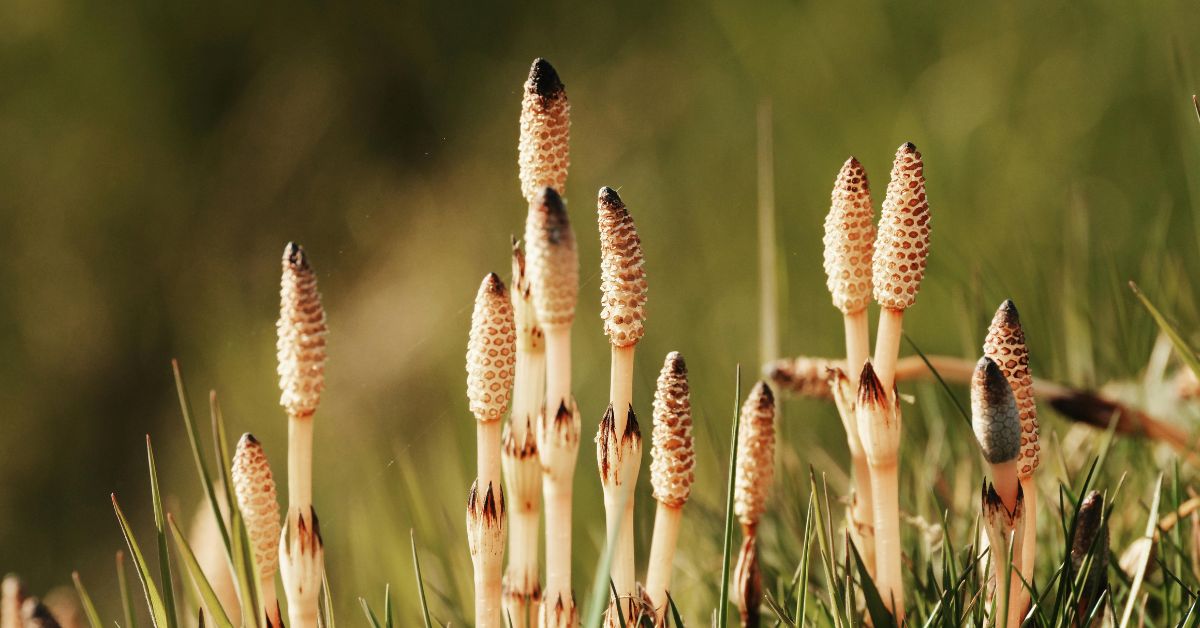
Field horsetail (Equisetum arvense) is one of the best-known medicinal herbs when it comes to urinary tract support and natural diuretic effects. It has been used for centuries for various urinary complaints, edema, and kidney-related issues, and today it is still commonly found in herbal tea blends, urinary support formulas, and diuretic preparations. What makes this plant particularly interesting is not only its mild diuretic effect, but also its exceptionally high mineral and silica content. However, field horsetail is not a herb that should be consumed continuously without breaks, so mindful use is important.
What is field horsetail?
Field horsetail (Equisetum arvense) is an ancient plant species whose aerial parts are primarily used in phytotherapy.
Its main active compounds include:
- silica derivatives
- potassium salts
- flavonoids
- saponins
Together, these compounds contribute to the plant’s:
- mild diuretic
- astringent
- urinary tract-supporting
properties.
Silica – one of field horsetail’s most remarkable components
One of the most distinctive features of field horsetail is its high silica content.
Silica:
- is an important structural component of connective tissues
- plays a role in tissue elasticity and structural integrity
For this reason, horsetail is not only used for urinary tract support, but is also commonly found in:
- hair care
- skin care
- nail-supporting
products.
Mild diuretic effect
One of the best-known effects of field horsetail is its mild diuretic action.
It may help:
- increase urine production
- support flushing of the urinary tract
- reduce fluid retention
Because of this, it is often used for:
- urinary tract discomfort
- mild water retention
- susceptibility to kidney gravel
Urinary tract infections and bladder discomfort
Field horsetail has traditionally been used to support inflammatory and infectious conditions of the lower urinary tract.
Its mild diuretic effect may:
- help flush the urinary tract
- support the elimination of bacteria
Its astringent properties may also:
- help soothe irritated mucous membranes.
Kidney gravel and kidney stones
Field horsetail is also frequently used in cases of:
- tendency toward kidney gravel
- minor urinary deposits
Increased urine flow may:
- support cleansing of the urinary tract
- help reduce stagnation
However, it is important to note that:
- larger kidney stones always require medical supervision
- herbal remedies do not replace proper medical treatment.
Post-traumatic edema
In phytotherapy, field horsetail is also used for post-traumatic edema.
Its mild diuretic action may:
- support fluid elimination
- help reduce swelling.
External use
Field horsetail can also be used externally.
It may be applied as:
- compresses
- baths
- rinses
Due to its astringent properties, it may also be useful for:
- irritated skin
- minor inflammations
- sensitive mucous membranes.
How is it used?
As a tea
The most common form of use is herbal tea.
General preparation:
- pour hot water over 1–2 teaspoons of dried herb
- let steep for 10–15 minutes
In herbal preparations
Field horsetail is often found in:
- capsules
- urinary tract tea blends
- combined herbal formulas
Baths and compresses
Externally, it may be used as:
- compresses
- sitz baths
- cleansing rinses
What should you pay attention to?
A few important considerations should be kept in mind when using field horsetail.
It is not recommended for:
- children
- edema caused by heart or kidney disease
- continuous long-term use
Long-term use
Field horsetail is best used in courses.
Continuous long-term consumption is not recommended.
Possible side effects
The plant may have a potential blood clot-promoting effect.
Therefore:
- individuals with clotting-related conditions should use it cautiously.
When can field horsetail be useful?
Field horsetail may be particularly beneficial if:
- urinary tract discomfort is present
- mild diuretic support is needed
- there is a tendency toward kidney gravel
- natural urinary tract support is desired
Field horsetail is one of the best-known natural diuretic herbs, primarily used for urinary tract complaints, kidney gravel, and mild edema. Its silica content gives it a unique place among medicinal herbs, while its mild astringent and urinary-supportive properties further contribute to its versatility.
When used properly, it can be a valuable addition to a natural home herbal toolkit — but mindful, course-based use remains essential.