
There are periods in life when everything simply feels harder. Getting out of bed in the morning takes effort, activities that once brought joy feel empty, fatigue becomes constant, and sleep is either excessive or restless and shallow. At such times, many people begin searching for natural solutions and almost inevitably come across St. John’s wort. But is it truly effective in depression? And perhaps even more importantly: when is an herbal remedy enough, and when is immediate medical help necessary?
Depression is more than just feeling low
It is important to say this clearly: depression is not a character weakness, nor is it simply a “bad phase.” It is a condition that affects the whole person — thoughts, emotions, energy levels, and even physical functioning. In severe cases, thoughts about death or self-harm may arise, which clearly require medical attention.
Phytotherapy may be considered primarily in cases of mild to moderate depression, and even then it requires conscious and responsible use.
Types of depression – the background matters
Depression is not a single, uniform condition; several forms are recognized.
Somatogenic depression has a physical cause. An accident, surgery, hormonal changes, or chronic illness can be burdensome not only physically but emotionally as well. In such cases, mood symptoms often improve alongside recovery from the underlying physical condition.
Reactive (psychogenic) depression develops as a response to a stressful life event. Grief, relationship crises, workplace stress, or prolonged emotional strain can all trigger it. Here, emotional processing, support, and addressing environmental factors play a key role.
Endogenous depression occurs without a clearly identifiable triggering event. Biochemical, neurological, and genetic factors affecting neurotransmitter balance may be involved.
Inherited predisposition, chronic stress, side effects of certain medications, chronic illnesses, hormonal changes — such as postpartum depression — and specific personality traits may all contribute to the development of depressive symptoms.
Symptoms that should not be minimized
Depressive symptoms often develop gradually. Interest decreases, familiar activities bring less pleasure. Persistent fatigue, sleep disturbances, concentration difficulties, and indecisiveness may follow. Mood becomes continuously low, the future feels narrowed, and thoughts about death may occur.
If such symptoms persist for at least two weeks and significantly impair daily functioning, professional consultation is strongly recommended.
The mechanism of action of St. John’s wort
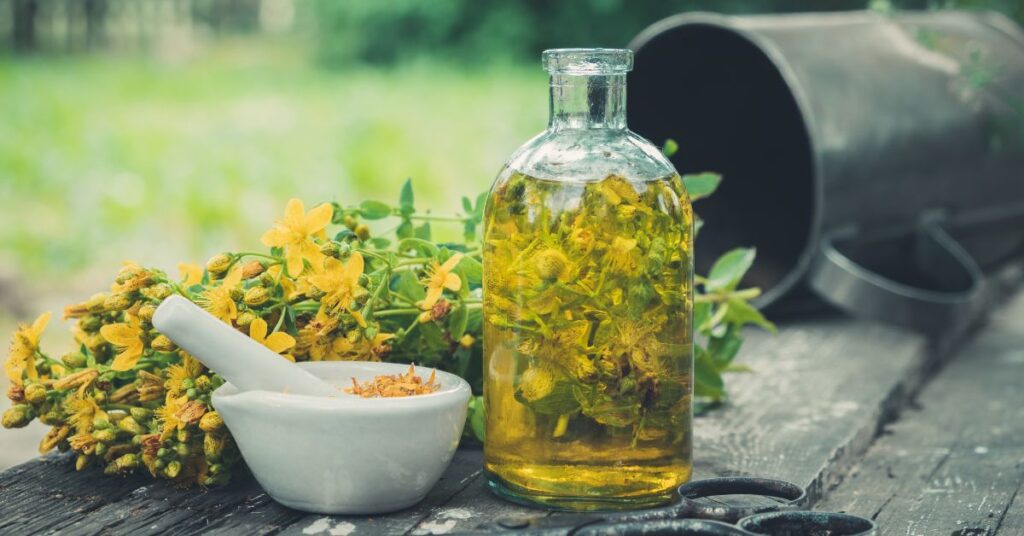
St. John’s wort (Hypericum perforatum) is one of the best-known mood-regulating herbs in phytotherapy. Medicinally, the aerial flowering parts are used.
Its main active constituents include hypericin, hyperforin, and flavonoids such as rutin and hyperoside. Hyperforin influences the reuptake of serotonin, dopamine, and noradrenaline, thereby supporting the nervous system’s mood-regulating mechanisms. Hypericin and flavonoids contribute antioxidant and neuroprotective effects to the overall action.
Based on human clinical studies, St. John’s wort is primarily recommended for mild to moderate depression. Several meta-analyses suggest that in such cases its efficacy may be comparable to certain synthetic antidepressants, while generally presenting a more favorable side-effect profile.
Tea or standardized extract?
Traditionally, St. John’s wort can be consumed as a tea. An infusion may be a good option for milder mood disturbances, especially when symptoms are linked to stress or exhaustion. Regular, daily consumption allows gradual absorption of active compounds.
Standardized extracts — available in capsule or tablet form — contain precisely defined amounts of active ingredients and may provide more predictable therapeutic effects in moderate cases.
It is important to note that St. John’s wort does not act immediately. At least two weeks are usually needed to notice the first signs of improvement, and full effects typically develop within four to six weeks. Treatment courses generally last four to six weeks, followed by a break and reassessment.
Contraindications and drug interactions
The use of St. John’s wort requires caution.
It may cause photosensitization, increasing skin sensitivity to sunlight. Significant drug interactions are well documented: it can affect hormonal contraceptives, anticoagulants, certain antidepressants, and immunosuppressive medications. When combined with antidepressants, there is a risk of serotonin syndrome.
It is not recommended during pregnancy or breastfeeding.
St. John’s wort is a valuable, scientifically studied herb for mild to moderate depression. Its effects develop gradually and, when used appropriately, it can genuinely support the restoration of emotional balance.
At the same time, depression can be a serious condition. If symptoms are severe, worsening, or accompanied by suicidal thoughts, immediate specialist care is essential. In such cases, phytotherapy may play a supportive role, but it does not replace psychiatric treatment.